
Welcome to our blog
Keep up with our latest demographic insights

What is “postsecondary attainment”? This post was co-authored with the John M. Belk Endowment. School administrators, policy analysts, and government officials have begun using the term “postsecondary attainment” when discussing successful educational outcomes. What does this mean? Postsecondary refers to education or training beyond high school. Attainment means the completion of a postsecondary degree or nondegree credential. Postsecondary attainment is not a one-size-fits-all concept. It includes postsecondary degrees, such as associate or bachelor’s degrees, awarded…

On February 20, the myFutureNC Commission announced a statewide attainment goal: by 2030, 2 million North Carolinians age 25-44 will hold a postsecondary degree or nondegree credential. This represents a 67% postsecondary attainment rate for this age group in 2030, a seventeen percentage point increase over the current attainment rate for this age group (50% in 2017). https://youtu.be/YU4CKSkcGSM This goal was set because recent trends in educational attainment are insufficient to meet projected demands for…

The United States economy is primarily driven by the economic activity within its metropolitan areas. From 2012 to 2017, 90% of the nation’s annual GDP was contributed by the nation’s 383 metros. This is to be expected, as 86% of the US population lives in a metropolitan statistical area. North Carolina follows a similar trend. In 2017, the state’s overall GDP was approximately $540 billion, and the combined metros totaled $476 billion, or 88%, of…

2,135,568 North Carolina households headed by a married couple or a householder with an unmarried partner. This represents 54% of all NC households. 5.8% Share of North Carolina households headed by a householder with an unmarried partner. This is lower than the national rate of 6.1%. Among the state’s counties with populations of 65,000 or more, Wayne County had the highest share of unmarried-partner households (8.3%), followed by Lincoln (8.1%), Wilkes (7.5%), and Randolph (7.4%)…
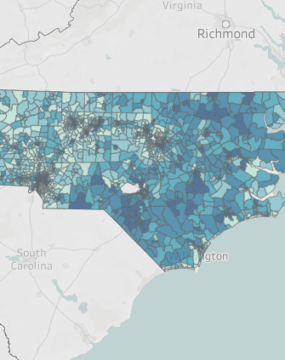
Counting all residents is a complex undertaking. Who is counted? And how does the Census Bureau capture unique populations, such as the homeless or military personnel? These questions, and more, were asked last week at "Making NC Count," the first statewide convening by the NC Counts Coalition. Here's what you need to know: Is it a law that everyone gets counted? Article 1 Section 2 of the Constitution mandates that the US take a Census…

Public school systems in the United States face an ongoing shortage of highly qualified teachers, largely due to high turnover in the field. In educational reporting, turnover may refer to teachers that leave the state public school system entirely (referred to as “attrition”) as well as those who transfer to another location within the state (referred to as “mobility”). A 2017 report from the Learning Policy Institute found that as much as 90% of open…

North Carolina’s population grew to an estimated 10.4 million people as of July 1, 2018, according to new estimates from the U.S. Census Bureau. From July 1, 2017 to July 1, 2018, the state’s population increased by nearly 113,000 individuals. This marks the third consecutive year that the state population has grown by more than 100,000 in a single year. Among the states, North Carolina had the 5th largest numeric increase since 2017. Only Texas (379K), Florida (323K), California…

Yesterday’s post provided topline statistics about internet access in North Carolina. For many readers, this post raised more questions than it answered. Specifically, one reader wanted to know how many individuals had internet access only through their cell phones. Others had more specific questions about the relationship between income, geography, and access. These questions are addressable with the data and are the focus of this post. How many of the people with internet access are…
Nationally, 78% of all households subscribe to the internet. This rate is two percentage points lower in North Carolina—76%—reflecting generally lower internet access rates among households in rural and lower-income counties. These data come from the 2017 5-Year American Community Survey (ACS) estimates recently released by the U.S. Census Bureau, the first data to provide estimates of computer and internet use for all communities. Across North Carolina’s 100 counties, internet access varies widely. In twelve…

Agriculture and agribusiness - i.e. food, fiber, and forestry - contributed nearly 17 percent (over $87 billion) to North Carolina's total economic output in 2016, and employed 730,000 of North Carolina's workers, according to a recent report from NC State. North Carolina is particularly known for two agricultural exports that will surely appear on many tables this Thanksgiving - turkey and sweet potatoes. #1 North Carolina’s rank in sweet potato production among all 50 states,…
Your support is critical to our mission of measuring, understanding, and predicting population change and its impact. Donate to Carolina Demography today.