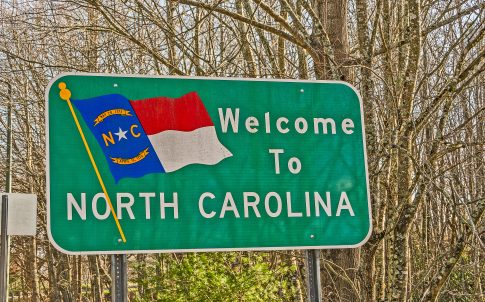
Earlier this month the Census Bureau released the 2025 city and town population estimates. These population estimates show how the city and town populations in North Carolina have changed between July 1st, 2024 and July 1st, 2025. North Carolina has been one of the fastest growing states over the past half-century. The Tar Heel State doubled its population between 1975 (5.5 million) and 2025 (11.2 million) and most of that growth has been in our big urban centers and surrounding areas.
Although North Carolina is still one of the fastest-growing states in the nations, population growth has slowed down compared to prior years, due almost entirely to a sharp decrease in net international migration. The slower growth rate at the state level is also reflected in the population change for North Carolina’s cities and towns.
In 2025, four cities in the Triangle reached new population milestones. The population of Raleigh passed 500,000, Apex passed 80,000, Holly Spring passed 50,000, and Garner passed 40,000. In total, the population in 385 of North Carolina’s 549 cities and towns grew between 2024 and 2025.
The town of Wendell saw the highest population growth (17.8%) between 2024 and 2025. From the 2020 Decennial Census to July 1st 2025, Wendell doubled their population from 9,841 residents to 19,687 residents! Zebulon, another town in the Raleigh-Cary metro area, saw the second-highest growth (13.9%), followed by Angier (13.2%). Almost half of the 50 fastest-growing cities and towns were in the Raleigh-Cary Metro or Greater Triangle area.
Cities and towns in coastal North Carolina also experienced higher population growth between 2024 and 2025. Particularly, cities and towns in Brunswick County saw higher growth, including Bolivia (7.1%) and Navassa (6.2%). Cities and towns in the Northeastern coastal area were also among the top 50 cities and towns with the highest growth rate in North Carolina (e.g., Morehead City (4.7%) and Surf City (3.4%).
Cities and towns with population loss were concentrated in the Northeastern and Western part of North Carolina. In Western North Carolina, Asheville and Boone lost population between 2024 and 2025 (-1.4% and -0.6%, respectively). In the Northeast, and specifically the Inner Coastal Plain, Roanoke Rapids (-1.4%) and Laurinburg (-2.3%) lost population between 2024 and 2025.
Small towns in Western North Carolina experienced the highest rates of population loss. Chimney Rock Village experienced the largest percentage loss with 10.6%, Old Fort lost 2.8%, and Marshall lost 2.4% of their population between 2024 and 2025. These towns, as well as Asheville and Boone, were all affected by Hurricane Helene which struck Western North Carolina in September 2024, destroying housing stock and displacing people. We anticipate the populations in those places to rebound in the coming years.
Need help understanding population change and its impacts on your community or business? Carolina Demography offers demographic research tailored to your needs.
Contact us today for a free initial consultation.
Contact UsCategories: Carolina Demographics

The Center for Women’s Health Research (CWHR) at the University of North Carolina School of Medicine released the 12th edition of our North Carolina Women’s Health Report Card on May 9, 2022. This document is a progress report on the…

Dr. Krista Perreira is a health economist who studies disparities in health, education, and economic well-being. In collaboration with the Urban Institute, she recently co-led a study funded by the Kate B. Reynolds Foundation to study barriers to access to…

Our material helped the NC Local News Lab Fund better understand and then prioritize their funding to better serve existing and future grant recipients in North Carolina. The North Carolina Local News Lab Fund was established in 2017 to strengthen…
Your support is critical to our mission of measuring, understanding, and predicting population change and its impact. Donate to Carolina Demography today.